
Choosing the Best Kratom Gummies: What to Compare Before Buying
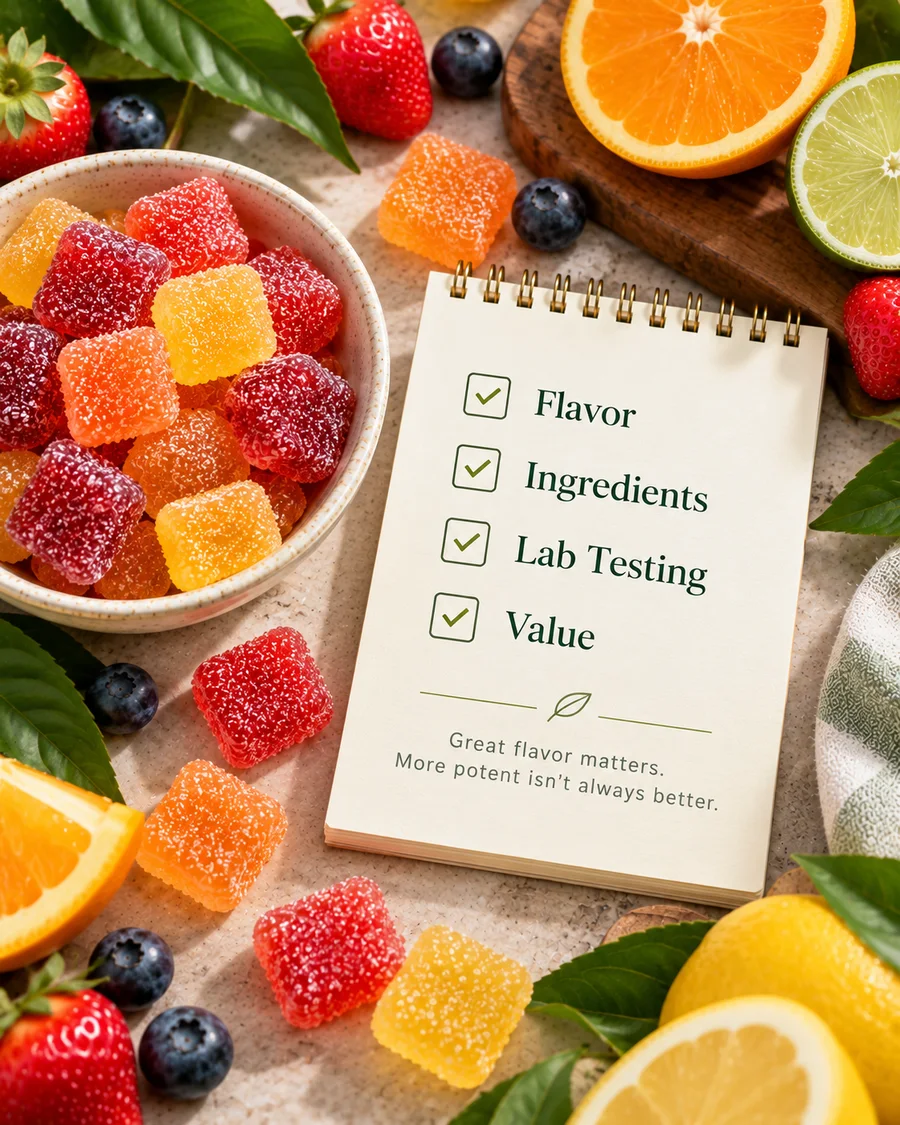
Look beyond potency. Compare flavor, clearly labeled contents, ingredients, lab reports, and value to make a more informed purchase.
On this page

The best kratom gummies are not necessarily the strongest. When comparing products, look beyond the biggest number on the package. Consider the flavor, clearly stated contents, complete ingredient information, testing you can verify, and the value of what you are actually buying.
At Panacea Natural, we believe flavor deserves more attention than potency bragging rights. If a gummy tastes so unpleasant that you regret buying it, an impressive milligram count has not made it a better purchase.
That does not mean ignoring potency or safety. It means judging the whole product rather than shopping by strength alone.
What to Compare When Buying Kratom Gummies
| What to compare | What to look for |
|---|---|
| Flavor and texture | A flavor you prefer, with useful customer feedback about sweetness, chew, and aftertaste. |
| Labeled contents | Clear identification of what the milligrams measure and whether they apply to one gummy, a serving, or the package. |
| Ingredients | A complete ingredient list and the dietary or allergen information you need. |
| Testing | Accessible reports that identify the product or sample, lot, and tests performed. |
| Value | Package count, unit price, shipping, and the product details—not potency alone. |
1. Prioritize Flavor Over a Potency Contest
When choosing a flavored gummy, taste should not be an afterthought.
Imagine comparing two products. One emphasizes its exceptionally high strength, but reviewers describe an overpowering aftertaste. The other provides clear content information and gets useful feedback about its flavor and texture. The first product does not automatically deserve your money simply because its number is bigger.
If a high-potency gummy tastes so bitter that you do not enjoy it, the extra strength has not improved your experience.
Our view is simple: flavor can matter more to your satisfaction than maximizing potency. You should not have to overlook a taste you dislike just to buy the strongest option available.
Look for reviews that describe the actual flavor rather than simply calling a product “good.” Is it very sweet or more tart? Is the texture soft or firm? Do reviewers mention a lingering aftertaste? Those details are more useful than a flavor name alone.
Keep taste and quantity separate, however. A pleasant flavor is not a reason to take extra gummies or exceed the label directions. Kratom carries risks, including dependence and adverse effects; a sweet format does not remove those concerns.[1]
2. Understand What the Milligrams Actually Mean
Before comparing two bags, make sure you are comparing the same measurement.
Mitragynine is a principal alkaloid in kratom.[2] A stated amount of kratom extract is not the same measurement as a stated amount of mitragynine. The weight of an ingredient does not, by itself, tell you how much of a particular compound it contains.
Also check whether the number applies to one gummy, the manufacturer's stated serving, or the entire package. “Ten gummies” describes a package count—not instructions to consume ten gummies.
Before ordering, you should be able to answer three questions: What is being measured? How much is stated per gummy? Where are the serving directions and warnings?
If the listing does not make those answers clear, ask the seller rather than guessing.
Check whether the product contains added or enhanced 7-OH
Do not treat every product described as a kratom gummy as interchangeable. The FDA specifically advises avoiding products with added or enhanced 7-hydroxymitragynine, also called 7-OH. That warning is distinct from the trace amounts that can occur naturally in kratom, and it does not establish that other kratom products are risk-free.[3]
3. Read the Ingredients Behind the Flavor
A tropical name or a picture of fruit is not a substitute for an ingredient list.
Check the sweeteners, gelling ingredients, flavorings, and any additional active ingredients. If you need vegan, gelatin-free, sugar-free, or allergen information, look for an explicit statement supported by the current label. Do not infer those characteristics from a product photograph.
There is no need to turn shopping into a chemistry exam. The goal is simply to understand what you are buying and identify anything that does not fit your dietary requirements. If important information is missing, contact the seller before placing an order.
Packaging can help you find the details you need. Read how kratom products are packaged and why cGMP practices matter for more background.
4. Look for Lab Reports You Can Actually Check
A “lab tested” badge is a starting point, not the whole answer.
Look for an accessible certificate of analysis, often called a COA. Check the product or sample description, lot number, testing date, and the results actually reported. Match the documentation to the product rather than assuming that any report on a website applies to everything it sells.[4]
Do not stop at potency. NIH notes that harmful bacteria and heavy metals have been found in some kratom products. Ask what contaminant testing is available as well as what alkaloid testing was performed.[1]
For more on tests beyond alkaloid content, read Kratom Testing Explained: Why Microbial Safety Matters More Than Potency Numbers.
A report provides information about the sample and tests shown; it is not a guarantee of safety or a prediction of your individual response.
For a detailed walkthrough, see our guide to reading kratom lab reports. You can also search Panacea Natural's lab report library by product, lot, or batch number.
5. Compare Value, Not Just the Bag Price
The cheaper package is not necessarily cheaper per gummy.
For example, a hypothetical $24 bag containing 12 gummies costs $2 per gummy. A $20 bag containing eight costs $2.50 per gummy. The second bag has the lower checkout price before shipping, but the higher unit price.
Price per gummy = package price ÷ number of gummies.
Use that calculation alongside the formulation, labeled contents, and shipping costs. It is a price comparison—not evidence that two gummies are equivalent or that either is an appropriate serving.
Flavor belongs in the value conversation, too. A bargain is less appealing when you dislike the product. Consider a smaller package before committing to a large order of an unfamiliar flavor, and read the seller's return policy before buying.
Frequently Asked Questions About Choosing Kratom Gummies
Are the strongest kratom gummies the best?
Not automatically. Strength is one product characteristic, not a complete quality score. Compare the flavor, labeled contents, ingredients, testing, and warnings rather than treating the highest milligram number as the deciding factor.
What should I look for in kratom gummy reviews?
Look for specific comments about taste, sweetness, texture, aftertaste, packaging, and customer service. Treat personal experiences as opinions, not proof of safety or a reliable guide to how a product will affect you.
Does a lab report mean kratom gummies are safe for everyone?
No. Testing can answer specific questions about a sample, but it does not eliminate kratom's risks or establish whether a product is appropriate for you. Kratom can cause dependence and adverse effects, and combinations with other drugs can be dangerous.[1]
Explore Panacea Natural's Tropical Blast Kratom Gummies
Putting this checklist into practice? Our Tropical Blast Kratom Gummies come in a 10-count package, with 25 mg of mitragynine listed per gummy. The product page includes a published lot-specific lab report and links to the report library.[5]
Review the current product details, ingredient information, and package directions before ordering. The per-gummy content is product information, not a personalized serving recommendation.
Our approach to choosing gummies is straightforward: look for a flavor you like, information you can verify, and value you can understand. A bigger potency number is not a substitute for any of those things.
View Tropical Blast Kratom Gummies and Product Details →
Comparing gummies with other formats?
If you are still deciding on a format, compare the product details for Green Maeng Da Kratom Capsules and Green Bali Kratom Powder alongside the gummies. Review each product’s ingredients, package information, directions, and lot-specific testing separately; the formats are not interchangeable serving measurements.
Important safety information: This guide is for adults and is not medical advice. Kratom can cause dependence and serious adverse effects. No kratom product is FDA-approved to treat a medical condition. Consult a healthcare professional before use, particularly if you take medications. Follow all package warnings and keep gummies in their original labeled packaging, away from children and pets.[1] [2] [5]
Sources
1. National Center for Complementary and Integrative Health. Kratom.
2. U.S. Food and Drug Administration. FDA and Kratom.
3. U.S. Food and Drug Administration. Products Containing 7-OH Can Cause Serious Harm.
4. Panacea Natural. Lab Report Library and How to Read Kratom Lab Tests.
5. Panacea Natural. Tropical Blast Kratom Gummies. Product details verified September 30, 2026; check current listing and package.