
How To Read Kratom Lab Tests
Learn how to read a certificate of analysis, match the lot number, and find microbial, heavy metal and alkaloid results on a kratom lab report.
On this page
Understanding a Certificate of Analysis (COA)
When shopping for kratom, you’ll often hear phrases like “lab tested” or “third-party tested.” But what do those lab reports actually mean... and how do you know the results apply to your specific product?
Watch the companion video
In this guide, we’ll walk through how to read a Certificate of Analysis (COA) step by step, using a real kratom lab report as an example. We’ll explain what each section means, how to match it to your product, and how to access lab results using lot numbers and QR codes.
Our goal is simple: to help you understand what you’re looking at, not just trust a label.
What Is a Certificate of Analysis (COA)?
A Certificate of Analysis, or COA, is a document issued by an independent, third-party laboratory. It shows the results of testing performed on a specific batch (or lot) of a product.
For kratom, a proper COA typically verifies:
- Microbiological safety (bacteria, yeast, mold)
- Heavy metals
- Alkaloid content and profile
- Sample identification and traceability
Importantly, a COA does not apply to a product name in general... it applies only to the exact batch that was tested.
Why COAs Matter in the Kratom Industry
Kratom is a botanical product, which means:
- Alkaloid levels naturally vary
- Improper handling can introduce bacteria or mold
- Environmental exposure can lead to trace heavy metals
A COA allows consumers to verify that:
- The product was tested by a legitimate lab
- Safety parameters were evaluated
- The results are documented and traceable
Transparency matters. A lab report you can read... and match to your product... matters even more.
Walking Through a Real Kratom COA (Line by Line)
Below, we’ll break down a real Certificate of Analysis for a batch of white kratom powder tested by Murray-Brown Laboratories .
1. Sample Identification & Batch Information
At the top of the COA, you’ll find:
- Sample ID
- Product description
- Lot or batch number
- Date received and analyzed
- Testing laboratory details
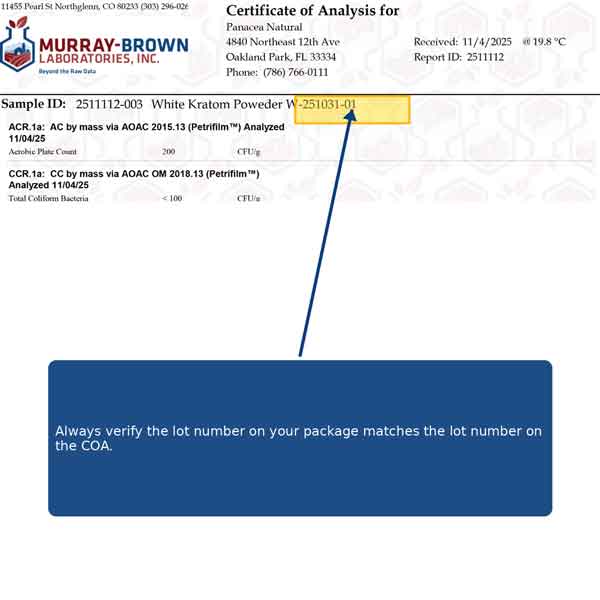
For example, this COA lists a sample identified as White Kratom Powder, with a batch/lot number W-251031-01 .
Why this matters:
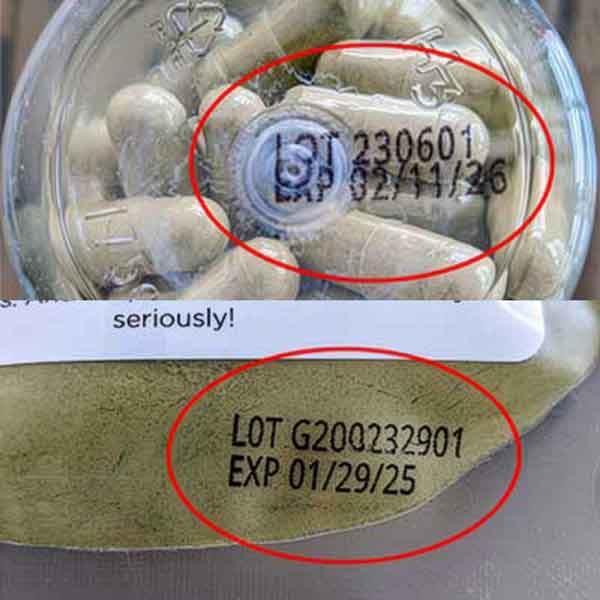
The lot number on the COA must match the lot number on your bottle or bag. If it doesn’t, the report does not apply to your product.
2. Microbiological Testing (Safety)
This section shows results for common microbial contaminants, including:
- Aerobic Plate Count
- Total Coliforms
- E. coli
- Salmonella
- Staphylococcus aureus
- Yeast and Mold
Results are typically reported in CFU/g (colony-forming units per gram).
In this COA:
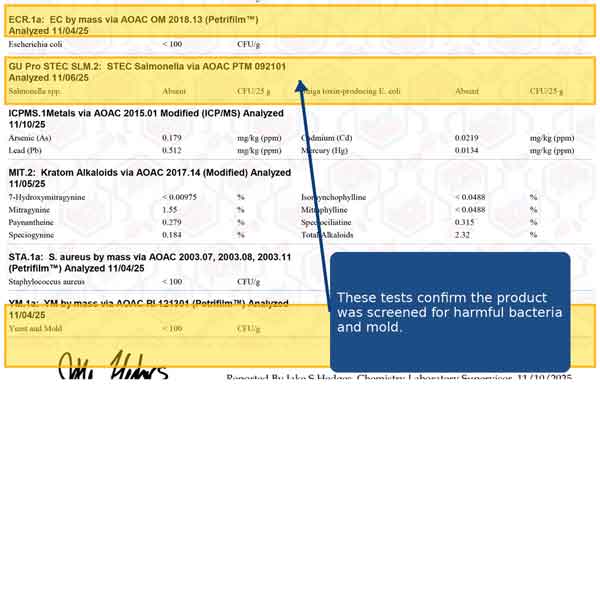
- Salmonella is reported as Absent
- E. coli is <100 CFU/g
- Yeast and mold are <100 CFU/g
What this tells you:
The sample meets established microbial safety criteria and shows no detectable pathogenic bacteria.
3. Heavy Metals Testing
Kratom is also tested for trace heavy metals, including:
- Arsenic (As)
- Lead (Pb)
- Cadmium (Cd)
- Mercury (Hg)
Results are reported in mg/kg (ppm).
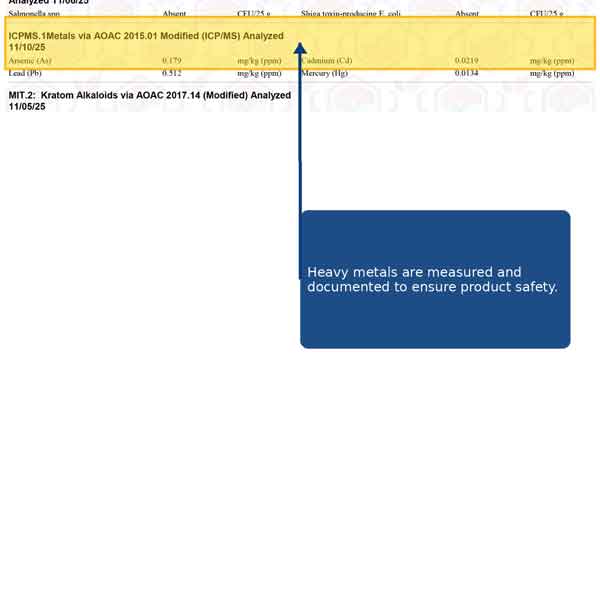
This COA shows measured values for each metal, all documented and quantified .
Important note:
The presence of a detectable number does not automatically mean a product is unsafe. What matters is that levels are tested, documented, and evaluated against safety standards.
4. Alkaloid Profile (Potency & Composition)
This section details the alkaloids naturally present in the kratom sample.
Key values shown in this COA include:
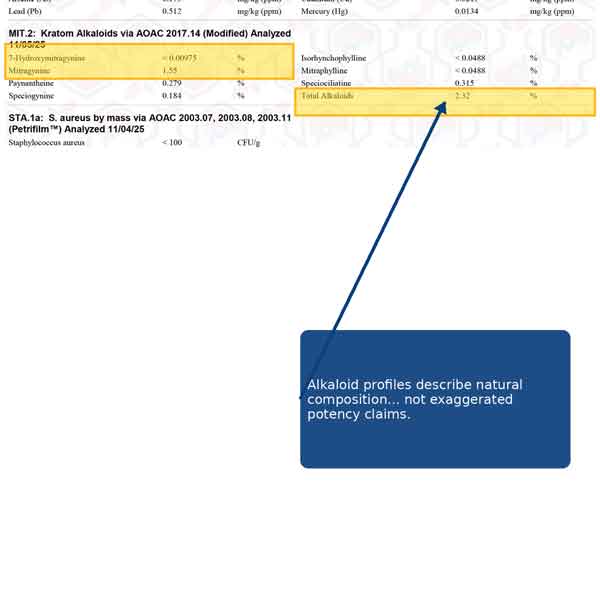
- Mitragynine: 1.55%
- Total alkaloids: 2.32%
- 7-Hydroxymitragynine: <0.00975%
- Why this matters:
Alkaloid profiles help characterize a batch’s natural composition. Reputable vendors report what’s present... they don’t exaggerate numbers or make unsupported potency claims.
How to Match a COA to Your Product
To verify that a lab report applies to your kratom:
- Locate the lot or batch number on your bottle or bag
- Find the same lot number listed on the COA
- Confirm the product description matches (capsules vs powder, strain/color)
If the lot numbers don’t match, the COA does not apply to that product.
How to Access Your Lab Results
At Panacea Natural, lab results are made easy to access:
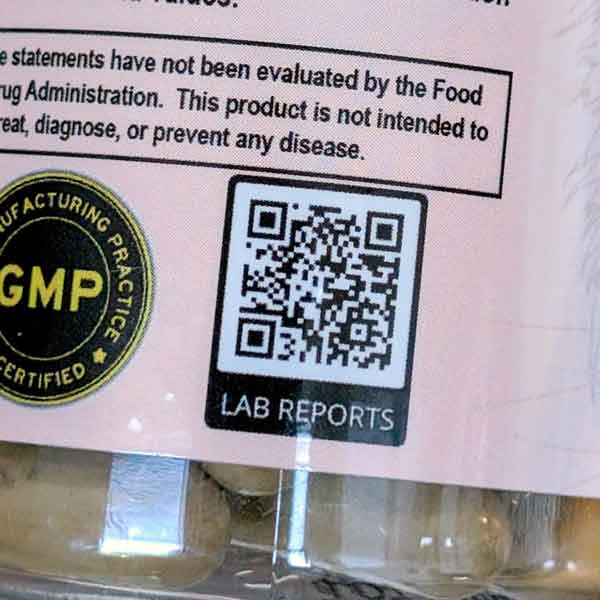
- Scan the QR code on your package to view testing information
- Enter your lot number on our website to pull the matching COA
- Visit the product detail page to view the most recent lab results
This ensures you can verify testing before or after purchase, not just take our word for it.
What to Look for in a Trustworthy Kratom COA
A legitimate COA should always include:
- A third-party laboratory name and contact information
- A clear sample and lot number
- Microbial testing results
- Heavy metals testing
- Alkaloid analysis
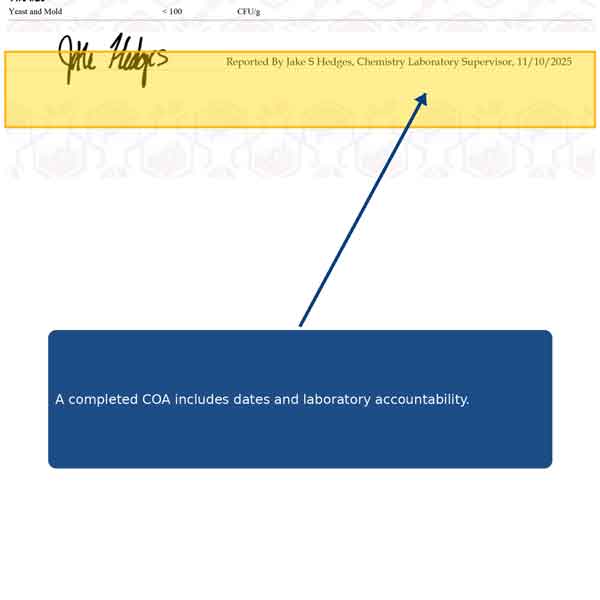
- Dates of analysis
- A lab supervisor’s sign-off
Transparency isn’t a feature... it’s a responsibility.
Final Thoughts
If you ever have questions about a lab report or need help locating the correct COA for your product, we’re always happy to help.